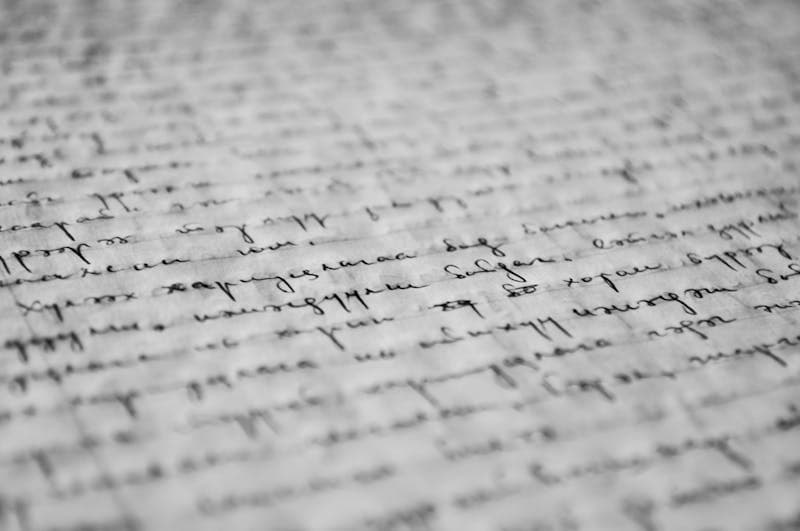
OCR on printed text is mostly a solved problem. Modern engines read typed pages at 99%+ accuracy in most languages and fonts. Handwriting is a different sport.
Everyone writes differently. The same person writes differently across the day depending on mood, speed, and the pen. Letters connect in odd ways, words overlap, lines drift. Doctors' notes are illegible to other doctors.
Even so, 2026 handwriting OCR is useful for real work. Meeting notes, journal entries, address labels, and structured forms come back with workable accuracy. Historical scripts, medical prescriptions, and scrawled receipts are still where the technology struggles.
The Image to Text tool runs OCR directly in your browser so you can test a scan without uploading the image to a third-party server.
How AI Reads Handwriting
A modern handwriting OCR pipeline runs five stages:
- Image preprocessing: deskew tilted text, binarize to black and white, strip background noise.
- Line segmentation: find each line of text. Easy on ruled paper, hard on freeform notes that fan out across the page.
- Word segmentation: split each line into words. The hard mode is cursive, where letters can bridge across word boundaries.
- Character recognition: feed each segmented word into a neural network (usually a CNN-RNN combo). The output is a probability for each possible character at each position.
- Language modeling: a language model re-scores the raw character probabilities so likely words win. "thr" followed by ambiguous characters becomes "three," not "thrap." This stage is where the accuracy gains live.
Visual recognition alone overfits to the image. Language modeling alone is just guessing. The combination is what makes the result usable.
After you extract text, run the Word Counter on the output to sanity-check that the length matches the page you scanned.

Accuracy by Handwriting Type
OCR results vary wildly by style.
- Neat printed: 90-95% character accuracy. Each letter is separate. Close to typed-text OCR.
- Neat cursive: 80-90%. Standard forms, connected letters. Confusion between e/l/i is the main failure mode.
- Casual mixed (print plus cursive): 70-85%. Most adult writing. Ambiguous letterforms cost most of the accuracy.
- Messy or rushed: 50-70%. Humans struggle here too. Language modeling carries most of the weight.
- Historical scripts: anywhere from 60 to 90%, depending on the script, ink condition, and paper damage. Specialized models on a known script outperform general OCR by a wide margin.
For any style, scanning beats a phone snapshot. Flat paper, even lighting, 300+ DPI, and high contrast between ink and background produce the most reliable text.
OCR results vary wildly by style.
Tools Ranked by Use Case
- Google Cloud Vision API: printed and handwritten text in 50+ languages.
DOCUMENT_TEXT_DETECTIONreturns paragraph and word boxes. Pay-per-use. Best general option for high-volume API work. - Microsoft Azure Computer Vision (Read API): very strong English handwriting, handles mixed print and script in the same document. Competitive with Google for most use cases.
- Apple Vision Framework: on-device on iOS and macOS, powers Live Text. The right pick when the image cannot leave the device.
- Amazon Textract: forms, tables, and receipts. Great when the document is structured; weaker on free-form notes.
- Mathpix: handwritten math to LaTeX. The default for STEM workflows.
- Transkribus: trained on historical scripts. The academic standard for archive digitization.
General rule: Google Vision and Azure Read for the API-based default, Apple Vision for privacy-sensitive on-device work, Mathpix and Transkribus for their respective niches.
If the OCR output mixes case, normalize it with the Text Case Converter before you pass it downstream.
Where Handwriting OCR Actually Earns Its Keep
- Meeting and whiteboard capture: snap the board, get searchable text. The single most common practical use.
- Receipts and expense reports: extract date, vendor, and total from handwritten receipts and feed them into accounting tools.
- Medical records: digitizing prescriptions and patient notes. Accuracy is still messy, but the human transcription load drops sharply.
- Education: turn handwritten student work into typed text for digital grading and for accessibility.
- Mail sorting: handwriting recognition has been running in postal sorting since the 1990s.
- Historical archives: museums and libraries (Transkribus is the big one) have digitized millions of manuscript pages into searchable text.
- Personal journaling: GoodNotes, Notability, and Apple Notes index handwritten content so you can search by keyword without converting anything.

FAQ
Can AI read cursive?
Yes, with lower accuracy than print. Neat cursive lands at 80-90% character accuracy in modern systems. Highly stylized or rushed cursive is still hard, and the language model carries most of the recovery.
Does it work offline?
Some of it. Apple Vision Framework runs fully on-device. Tesseract OCR can run locally with the right language packs. Google, Microsoft, and Amazon all require a network connection. Pick on-device when the page is sensitive.
How do I push accuracy higher?
Dark ink, plain white paper, larger letters, clear word spacing, print where you can, and scan at 300+ DPI instead of using a phone snapshot. Those changes alone push accuracy up by 10-20% on most documents.
Can AI learn my handwriting specifically?
Some systems do. Apple's on-device model adapts with use. Cloud OCR can be fine-tuned with 50-100 labeled pages of your handwriting, which mostly pays off for organizations digitizing big archives from a few writers.
LLM Pricing Comparison 2026: How Much Does AI Really Cost?
LLM pricing compared: GPT-4o, Claude, Gemini, Llama, Mistral, DeepSeek. Cost per million tokens, batch discounts, and budget examples to plan your AI spend.
How to Fine-Tune LLMs: Data Format Guide for 2026
Fine-tuning data format guide for OpenAI, Anthropic, and Google. JSONL examples, validation tips, and best practices for preparing training data.
AI Context Windows and Token Limits Explained
Context window and token limits explained: what they are, how they differ across GPT-4o, Claude, and Gemini, and strategies for managing token constraints.