
Every time you pick up a die and roll it, you are running a tiny probability experiment. A single six-sided die has six equally likely outcomes, each with a 1-in-6 chance of landing face up. Simple enough. But the moment you start rolling multiple dice, adding modifiers, or looking for specific combinations, the math gets genuinely interesting.
Understanding dice probability is not just useful for tabletop games. It is foundational for statistics, risk assessment, game design, and even decision making in business contexts. The principles behind "what are the odds of rolling at least one six with three dice" are the same principles behind "what are the odds of at least one server failing in a cluster of three."
Whether you are a Dungeons & Dragons player trying to figure out if that attack is worth the risk, a board game designer balancing mechanics, or a student learning probability, dice are the most intuitive way to grasp these concepts.
Single Die Probability: The Foundation
A standard six-sided die (d6) gives each number an equal probability of 1/6, or about 16.67%. This is what mathematicians call a uniform distribution. Every outcome is equally likely.
But not all dice are six-sided. Tabletop RPGs use a full set: d4 (four sides), d6, d8, d10, d12, and d20. A d20 gives each number a 1/20 chance, or 5%. Rolling a natural 20 in D&D feels rare because it is. You will roll it once every 20 rolls on average.
The probability of rolling a specific number on any die is simply 1 divided by the number of sides. The probability of rolling at least a certain number is the count of favorable outcomes divided by total outcomes. On a d20, the probability of rolling 15 or higher is 6/20 (the numbers 15, 16, 17, 18, 19, 20), which equals 30%.
The Dice Roller lets you roll any combination of dice instantly. Instead of doing the mental math, roll a few hundred times and see the distribution yourself. It is faster than calculating and more convincing than formulas.
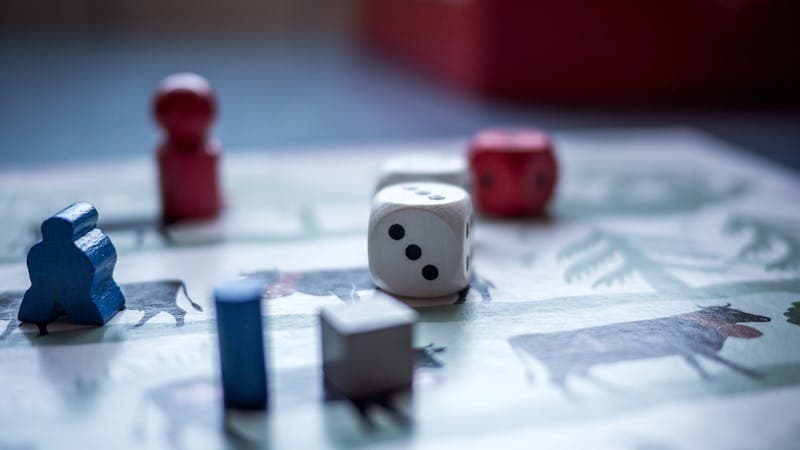
Multiple Dice: Where It Gets Interesting
Rolling two d6 dice and adding them together is the classic probability problem. There are 36 possible combinations (6 times 6), but the sums are not equally likely. There is only one way to roll a 2 (1+1) but six ways to roll a 7 (1+6, 2+5, 3+4, 4+3, 5+2, 6+1).
This creates a bell curve distribution. The most likely outcome when rolling 2d6 is 7, with a probability of about 16.67%. The extremes (2 and 12) each have only a 2.78% chance. This bell curve gets more pronounced as you add more dice. Rolling 3d6 produces a sharper peak around 10-11, and rolling 10d6 gives you a distribution so tight that results far from the average of 35 almost never happen.
This is actually the Central Limit Theorem in action. Regardless of the underlying distribution of individual dice, the sum of many independent dice rolls approaches a normal (bell curve) distribution. It is the same principle that makes averages of large samples predictable even when individual measurements are random.
For game designers, this is a crucial insight. A system that uses 1d20 for everything has wild swings in outcomes. A system that uses 3d6 produces much more predictable, consistent results. The choice between these approaches defines the feel of the game.
Rolling two d6 dice and adding them together is the classic probability problem.
Practical Probability: Common Dice Questions Answered
What are the odds of rolling at least one 6 on three dice?
The easiest way to calculate this is to find the probability of NOT rolling any sixes and subtract from 1. The probability of not rolling a 6 on one die is 5/6. For three dice: (5/6)^3 = 125/216 = about 57.9% chance of zero sixes. So the probability of at least one 6 is 1 minus 0.579 = about 42.1%.
What are the odds of rolling doubles with two dice?
There are 6 ways to roll doubles (1-1, 2-2, 3-3, 4-4, 5-5, 6-6) out of 36 total combinations. That is 6/36 = 16.67%, or exactly 1 in 6.
What is the average roll on a d20?
The average of any die is (minimum + maximum) / 2. For a d20: (1 + 20) / 2 = 10.5. This means over many rolls, your average will converge toward 10.5. This is useful for game balance calculations.
What are the odds of rolling 18 on 3d6 (the perfect ability score)?
You need all three dice to show 6. That is (1/6)^3 = 1/216 = about 0.46%. In a lifetime of character creation, most D&D players will see this only a handful of times.
The Coin Flipper works on the same probability principles but with just two outcomes. It is the simplest case: 50/50 chance, every flip independent of the last.

Dice Rolling for Decision Making
Outside of games, dice and random generators serve a surprisingly practical purpose: breaking decision paralysis. When you have two roughly equal options and cannot decide, randomness is genuinely rational.
This is not flippant advice. Decision researchers have shown that when options are closely matched in value, the cost of deliberating often exceeds the difference in value between the options. Spending 30 minutes agonizing over which restaurant to visit costs more in time and mental energy than the difference in meal quality.
Some practical applications:
Randomized task ordering. If you have five tasks of roughly equal priority, roll a d6 (reroll 6) to pick which one to start with. This eliminates the meta-work of prioritizing tasks that do not need prioritizing.
A/B testing with small samples. When you need to randomly assign participants to two groups, a coin flip or dice roll provides true randomness without needing software.
Tie-breaking in group decisions. When a vote is split evenly, a dice roll is perceived as more fair than a manager simply choosing. The Random Name Generator works on similar principles for randomly selecting from a list of options.
Creative constraints. Roll dice to randomly select writing prompts, color palettes, or design constraints. Random constraints often produce more creative results than unconstrained freedom because they force you to think in directions you would not have chosen.
Outside of games, dice and random generators serve a surprisingly practical purpose: breaking decision paralysis.
Digital Dice vs Physical Dice: Is There a Difference?
Physical dice are not perfectly random. Manufacturing imperfections, rounded edges, and material density variations create tiny biases. Casino dice are precision-machined with sharp edges and translucent material to minimize these effects, but your average board game die is far from perfect.
Studies have shown that cheap dice can have biases of several percentage points. A d6 with a slight weight imbalance might roll 6 at 18% instead of the expected 16.67%. Over a casual game night, this difference is negligible. Over thousands of rolls in a competitive setting, it can matter.
Digital dice rollers use pseudorandom number generators (PRNGs) that are, for all practical purposes, perfectly uniform. A well-implemented PRNG produces each outcome with essentially identical probability. There is no wear, no weight imbalance, and no technique that can influence the result.
The trade-off is the tactile experience. Rolling physical dice is satisfying in a way that clicking a button is not. The sound, the anticipation while the die tumbles, the communal experience of everyone watching the same die. For tabletop gaming, physical dice are part of the experience even if digital dice are technically more fair.
For anything where fairness and statistical accuracy matter, digital dice are objectively better. For anything where the experience matters, physical dice are irreplaceable.
Probability Distributions Beyond Dice
Once you understand dice probability, you have a mental model for much more complex distributions. Dice are discrete uniform distributions (each side equally likely), but the same principles extend to:
Weighted dice / loaded outcomes. Not every outcome needs to be equally likely. In game design, drop tables often use weighted randomness where rare items have a 1% chance and common items have a 30% chance. The math is the same as dice, just with unequal probabilities.
Continuous distributions. Instead of landing on one of six numbers, imagine a spinner that can land anywhere on a circle. This is a continuous uniform distribution. Temperature readings, timing measurements, and stock price movements follow continuous distributions.
Poisson distribution. How many customers arrive per hour, how many errors occur per day, how many dice rolls it takes to get your first 6. These "how many events in an interval" questions follow the Poisson distribution, which is intimately related to dice probability.
Monte Carlo simulation. Roll thousands of virtual dice to estimate complex probabilities that are hard to calculate analytically. Insurance companies, financial analysts, and engineers all use Monte Carlo methods daily. The concept is literally just "roll dice many times and count the results."
Once you understand dice probability, you have a mental model for much more complex distributions.
FAQ
Are online dice rollers truly random?
Online dice rollers use pseudorandom number generators (PRNGs) that produce results indistinguishable from true randomness for all practical purposes. Browser-based tools typically use Math.random() or the Web Crypto API, both of which are more than adequate for fair dice simulation. For cryptographic purposes, hardware random number generators exist, but for gaming and probability experiments, PRNGs are perfectly fine.
Does the outcome of one dice roll affect the next?
No. Each dice roll is an independent event. Rolling three sixes in a row does not make the next roll more or less likely to be a six. This misconception is called the gambler's fallacy, and it is one of the most common errors in probability thinking. The die has no memory of previous rolls.
How many dice rolls do I need for results to match the expected probability?
The law of large numbers says that as the number of trials increases, the observed frequency converges toward the expected probability. For practical purposes, around 100 rolls gives you a reasonable approximation, and 1,000 rolls gets you quite close. With 10,000 rolls, the deviation from expected values is usually minimal.
Can you use dice for serious statistical work?
Yes. Before computers, statisticians used physical dice and random number tables for sampling and experimental design. Today, digital dice rollers serve the same purpose for small-scale randomization. For large-scale statistical work, dedicated software like R or Python provides more powerful random number generation and analysis tools.
10 Fun Online Tools You Didn't Know You Needed
Discover fun online tools with surprisingly practical uses. From dice rollers to meme generators, these free browser tools solve real problems.
How to Convert PDF to JPG Free (Without Uploading)
Convert PDF to JPG free in your browser with no upload, no signup, and no watermark. Plus how to pick pages, compress, and resize the output.
Random Number Generator: Practical Uses Explained
Learn how random number generators work and when to use them, from statistical sampling and game design to fair draws and unbiased decisions.
AI Domain Name Generator: Find a Business Domain
An AI domain name generator produces brandable, available domain names for your business or startup. Learn how these tools work and what makes a name stick.