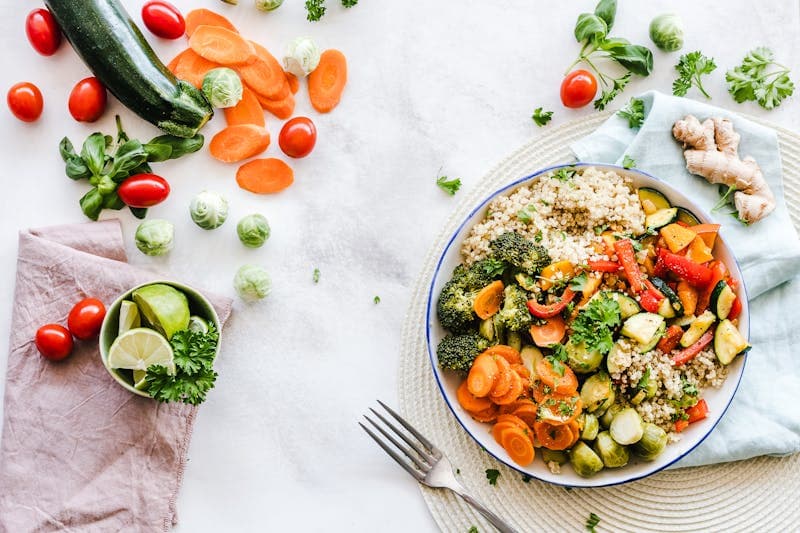
Meal prep sounds like a productivity hack that only works if your life is already together. You see Instagram posts with rows of perfect containers, each holding exactly 42 grams of brown rice and a precisely weighed chicken breast. That looks exhausting, not efficient.
Meal prep does not have to look like that. At its core, it is deciding what you will eat for the week, buying ingredients once, and doing most of the cooking in a single session. The math (calories, portions, grocery quantities) is where most people quit. Calculators handle that part so you can focus on food.
Step 1: Calculate Your Daily Calorie and Macro Targets
Before you plan meals, you need to know what you are aiming for. A Calories Calculator gives you a daily target based on your age, weight, height, activity level, and whether you want to maintain, lose, or gain weight.
For most adults, maintenance calories fall between 1,800 and 2,800 per day. If you want to lose weight, a deficit of 300-500 calories per day is sustainable without feeling miserable. If you want to gain muscle, a surplus of 200-400 calories works for most people without excessive fat gain.
Once you have a calorie target, split it into macronutrients. A balanced starting point for most people:
- Protein: 25-30% of calories (about 1.6-2.2g per kg of body weight for active people)
- Carbohydrates: 40-50% of calories (more if you exercise intensely, less if sedentary)
- Fat: 25-30% of calories (minimum 0.5g per kg for hormonal health)
These ratios are starting points. Adjust based on how you feel after the first week. If you are constantly hungry, increase protein and fiber. If your workouts suffer, increase carbs around training sessions.
Step 2: Build Your Meal Template
The secret to sustainable meal prep is not having 21 unique meals per week. It is having 4-5 meal templates that you rotate. A meal template is a formula, not a recipe:
Template 1 - Bowl: grain base + protein + roasted vegetables + sauce Template 2 - Wrap: tortilla + protein + raw vegetables + dressing Template 3 - Sheet pan: protein + two vegetables + seasoning, all roasted together Template 4 - Soup/stew: protein + vegetables + broth + starch, all in one pot Template 5 - Salad: greens + protein + grain/legume + nuts + dressing
Each template can produce dozens of different meals by swapping ingredients. A bowl could be rice with chicken and broccoli on Monday, quinoa with tofu and peppers on Wednesday, and couscous with salmon and asparagus on Friday. Same template, different taste.
This approach works because it reduces decision fatigue. You are not choosing between 500 recipes. You are choosing which protein goes with which vegetable in a format you already know how to cook.
Use a Unit Converter when scaling recipes. If a recipe serves 4 but you need 6 portions, convert all measurements proportionally. This is especially useful for baking where precision matters.
Step 3: Calculate Grocery Quantities
This is where most people either buy too much (wasting food and money) or too little (scrambling for extra meals mid-week). The math is straightforward but tedious to do by hand.
For each meal, calculate the raw ingredient weight per serving, then multiply by the number of servings you need for the week. Account for cooking losses: meat loses about 25% of its weight when cooked, vegetables lose 10-20%, and grains absorb water and roughly double in volume.
Example calculation for chicken breasts: - Target: 150g cooked chicken per meal, 5 lunches per week - Cooking loss: approximately 25% - Raw weight needed per meal: 150g / 0.75 = 200g - Weekly total: 200g x 5 = 1,000g (1 kg)
A Percentage Calculator speeds up these cooking loss calculations. If your recipe says 500g raw and you need to know how much cooked food that produces, calculate 75% of 500g to get approximately 375g.
Do the same calculation for every protein, grain, and produce item. Write it all on one list grouped by grocery store section (produce, meat, dairy, pantry) so you can shop in a single efficient trip.
Step 4: The Cooking Session
A good meal prep session takes 1.5 to 3 hours depending on how many meals you are preparing. The key is running things in parallel, not cooking one dish at a time.
Start with anything that takes the longest. Put grains on the stove (rice, quinoa, pasta) since these cook passively. While grains cook, season and put proteins in the oven. While both of those are going, chop vegetables and prepare sauces or dressings.
Here is a sample timeline for prepping 10 meals:
0:00 - Start rice cooker, preheat oven 0:05 - Season chicken, place on sheet pan, put in oven 0:10 - Chop all vegetables for the week 0:25 - Start roasting half the vegetables (second sheet pan) 0:30 - Make 2 sauces/dressings 0:40 - Check and flip chicken 0:45 - Raw vegetables into containers for salads and wraps 0:55 - Chicken done, let it rest, then slice 1:00 - Rice done, roasted vegetables done 1:05 - Assemble all containers 1:20 - Clean up
That is 10 meals in under 90 minutes. The per-meal time investment is about 8 minutes, which is faster than any delivery app.
A good meal prep session takes 1.5 to 3 hours depending on how many meals you are preparing.
Storage and Food Safety
Prepped meals last 3-5 days in the refrigerator and 2-3 months in the freezer. The practical approach is to refrigerate meals for the next 3-4 days and freeze anything beyond that.
Some foods do not hold up well in the fridge for multiple days. Cooked pasta gets mushy. Crispy items lose their texture. Dressings make salads soggy. The solution is to store components separately and assemble just before eating. Keep grains, proteins, and sauces in separate containers.
Glass containers are better than plastic for reheating since they do not warp or leach chemicals. They also do not absorb odors from garlic or curry. The upfront cost is higher, but they last for years.
Let cooked food cool to room temperature before sealing containers and refrigerating. Putting hot food directly into the fridge raises the temperature inside, which can compromise other stored food. But do not leave food at room temperature for more than 2 hours, as bacteria multiply rapidly in the danger zone (4-60 degrees Celsius).
Label containers with the date they were prepped. It sounds obsessive, but after a few weeks of meal prepping, you will have containers in various stages and forgetting which is which leads to wasted food or worse.
Budget Impact of Meal Prepping
The financial argument for meal prep is strong. Eating out or ordering delivery for lunch costs roughly $10-15 per meal in most cities. Home-cooked meal prep costs $3-5 per meal depending on your protein choices and where you shop.
That difference adds up quickly. Five workday lunches prepped at home instead of purchased saves roughly $40-60 per week, or $160-240 per month. Over a year, that is $2,000-3,000 in savings from changing just one meal per day.
The savings increase when you buy in bulk. A 2kg bag of rice costs less per serving than individual portions. Buying family packs of chicken and portioning them yourself is cheaper than pre-cut pieces. Frozen vegetables are typically cheaper than fresh, nutritionally equivalent, and last much longer.
There is also less food waste. When you buy exactly what you need for the week's plan, nothing sits in the back of the fridge slowly decomposing. The average household throws away roughly 30% of the food they buy. Meal prepping drops that number close to zero because every ingredient has a designated meal.
The financial argument for meal prep is strong.
FAQ
Is it safe to eat meal-prepped food that is 5 days old?
Most properly stored cooked food is safe for 3-4 days in the refrigerator, according to food safety guidelines. Day 5 is pushing it for some foods, especially those with dairy or seafood. If you are prepping for a full 7-day week, freeze meals for days 5-7 and thaw them the night before.
How do I prevent meal prep from getting boring?
Rotate your sauce and seasoning combinations weekly. The same chicken and rice tastes completely different with teriyaki sauce versus chimichurri versus a Thai peanut dressing. Changing the sauce is the fastest way to create variety without changing your base ingredients.
Can I meal prep if I have dietary restrictions?
Absolutely. Meal prepping actually makes dietary restrictions easier because you control every ingredient. Gluten-free, dairy-free, vegetarian, keto, halal, or any other restriction is simpler when you cook everything yourself rather than relying on restaurants to get it right.
Do I need special containers?
You can start with whatever containers you already have. If you want to invest, look for glass containers with snap-lock lids that are microwave-safe, dishwasher-safe, and do not leak. A set of 10 containers in the 800ml to 1-liter range covers most meal prep needs. Two-compartment containers are useful for keeping wet and dry components separate.
Free Health Calculators: BMI, Calories, Water Intake
Health calculators for BMI, daily calories, water intake, and sleep cycles. Free tools that give you real numbers to work with instead of guesses.
Sleep Calculator: Find Your Ideal Bedtime
Use a sleep calculator to find your ideal bedtime from sleep cycles. Learn how 90-minute cycles work, why waking mid-cycle makes you groggy, and how to fix it.
Heart Rate Zones: Calculate Your Target Training Zones
Calculate target heart rate zones for training. Apply the Karvonen formula, set zone-based training intensities, and get more from each cardio workout.